
Light Requirements
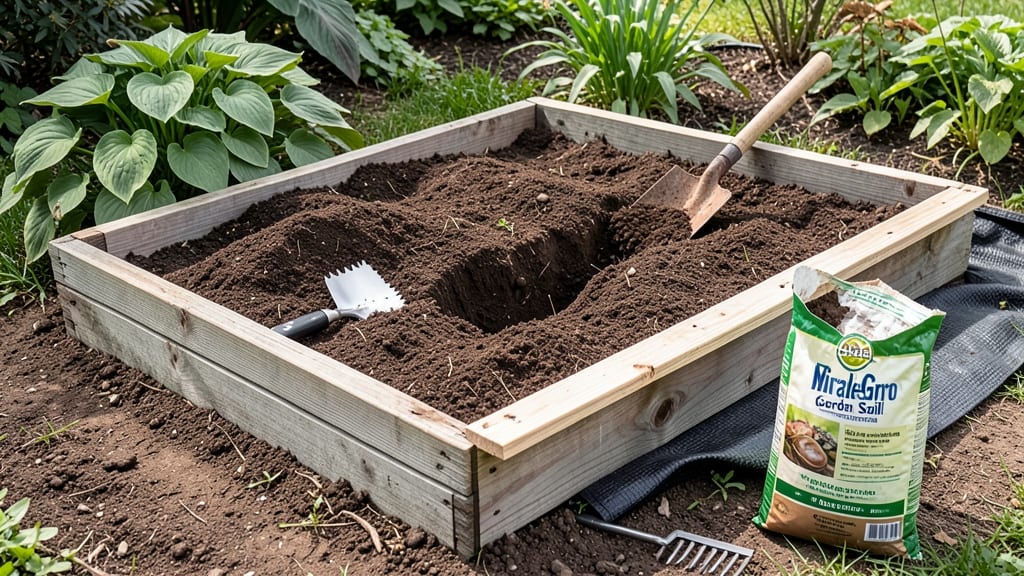
Filling a raised garden bed with the right amount of soil depends on your plants' root depth and the bed's dimensions 🌱 — and skipping the math can leave you with either wasted soil or stunted growth.
Picture this: You've poured bags of fresh soil into your raised bed, only to realize halfway through that your tomatoes need 12 inches of depth, but your carrots are happy with just 6.
Or maybe you've overestimated and now have a mountain of leftover soil taking up space. These are the kinds of mistakes that turn a simple project into a costly lesson.
In this guide, I’ll break down exactly how much soil you need for different plant types, how to calculate it for any bed size, and how to layer your soil for the best drainage and nutrients.
Whether you're working with a 4x8-foot bed or a small 2x4-foot planter, you’ll walk away with a clear, step-by-step plan.
You’ll also discover cost-saving tips for mixing your own soil, common pitfalls to avoid, and how to adjust for drainage—so your raised bed becomes the thriving garden you’ve always wanted, not a guesswork experiment.
Raised garden bed soil depth guide by plant type and root needs
When filling your raised garden bed, the soil depth isn’t one-size-fits-all. Different plants have unique root depth requirements, and getting this wrong can mean the difference between a thriving harvest and struggling seedlings.
For example, shallow-rooted herbs like basil need just 6-12 inches of soil, while deep-rooted vegetables like carrots or asparagus demand 12-18 inches to flourish. Understanding these needs ensures your plants have space to grow without crowding or nutrient competition.
Most gardeners make the mistake of using uniform soil depth across all plants, which can lead to wasted soil or poor growth. For instance, filling a bed with only 6 inches of soil works for lettuce but fails for tomatoes, whose roots can extend 3-4 feet deep.
The key is tailoring your soil depth to the plants you’re growing, whether it’s vegetables, herbs, fruits, or flowers. This approach also helps with drainage and aeration, two critical factors for root health.
Below is a root depth chart to guide your soil filling, organized by plant type. Use this as a reference when planning your raised bed layout. For example, if you’re growing a mix of radishes (shallow roots) and potatoes (deep roots), you’ll need to allocate space accordingly.
Pro tip: Group plants with similar root depth needs together to simplify soil management.
For deep-rooted plants like tomatoes or asparagus, aim for at least 18 inches of soil depth. These plants need room to establish strong root systems, which directly impacts their ability to absorb water and nutrients.
If your raised bed is only 6-12 inches deep, consider growing shallow-rooted crops like lettuce or herbs instead. Alternatively, you can create "pockets" of deeper soil by adding compost or topsoil in layers around the roots of deeper plants.
Another common mistake is over-filling the bed with soil, which can lead to compaction and poor drainage. While deeper soil is better for some plants, it’s not always necessary. For instance, annual flowers like marigolds thrive in just 12 inches of soil.
Focus on the specific needs of your plants rather than assuming more soil is always better. Always leave 1-2 inches of space at the top for mulch or watering without spilling over the edges.
If you’re growing a mix of plants with varying root depth needs, consider dividing your raised bed into sections. For example, dedicate one side to shallow-rooted greens and the other to deep-root
How to calculate soil volume for your raised garden bed (with formula)
Calculating the exact amount of soil needed for your raised garden bed prevents wasted trips to the nursery and ensures your plants get the ideal growing environment. The key lies in understanding your bed's dimensions and adjusting for the bulk density of your soil mix.
A 4'x8' bed filled with 12 inches of topsoil isn't the same as one filled with a compost-heavy mix—each requires different volume calculations.
Start by measuring your bed's length, width, and depth. For example, a standard 4-foot-wide bed with 10-inch depth and 8-foot length needs precise math. Multiply these dimensions, but don’t stop there—account for settlement (soil compacting over time) and the type of soil mix you’re using.
A mix with perlite or vermiculite will have a looser bulk density than pure topsoil, meaning you’ll need more volume.
- Measure your bed: Length (L) × Width (W) × Depth (D) in feet
- Calculate cubic feet: L × W × D = cubic feet
- Convert to cubic yards: Divide cubic feet by 27 (1 yard³ = 27 ft³)
- Adjust for bulk density: Pure topsoil = 1.0, compost-heavy = 0.6-0.8
- Add 10% extra: Account for settlement and uneven edges
- Example: 4'×8'×1' bed = 32 ft³ → 1.19 yd³ → Buy 1.3 yd³ for compost mix
Let’s break down the formula step-by-step. First, multiply your bed’s length, width, and depth in feet to get cubic feet. For a 4-foot-wide bed with 10-inch depth (0.83 ft) and 8-foot length: 4 × 8 × 0.83 = 26.56 cubic feet.
Convert this to cubic yards by dividing by 27 (26.56 ÷ 27 ≈ 0.98 cubic yards).
Now, adjust for bulk density. Pure topsoil has a bulk density of about 1.0, but a mix with 50% compost might be 0.7. Multiply your cubic yards by the bulk density factor (e.g., 0.98 × 0.7 = 0.69 cubic yards).
Finally, add 10% extra to account for settlement and uneven edges, rounding up to 0.76 cubic yards. This ensures you have enough soil to avoid running short.
For cost savings, consider layering your soil. Start with a 2-inch layer of gravel or coarse sand at the bottom for drainage, then add a 6-inch layer of compost or aged manure, and top with 4-6 inches of topsoil.
This approach reduces the total volume needed while improving drainage and nutrient retention. Always label your soil bags to track what you’ve used—this helps avoid over-purchasing.
Common mistakes include ignoring settlement or using the wrong bulk density factor. For instance, assuming a compost-heavy mix behaves like topsoil can leave you short.
Another pitfall is forgetting to account for existing soil if your raised bed sits on grass or dirt—subtract the depth of any existing layer from your total. Pro tip: Use a soil calculator online to double-check your math before heading to the store.