
Tools
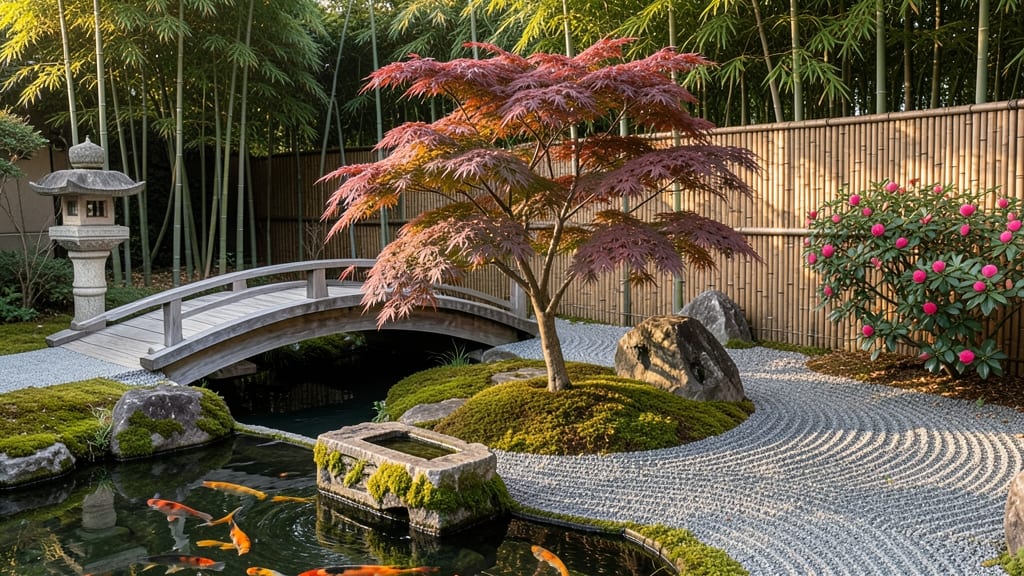
Los Angeles' Japanese gardens create peaceful retreats by harmonizing traditional Japanese design with California's natural beauty, showcasing serene koi ponds, carefully cultivated bonsai trees, and native stone arrangements at iconic locations like the Huntington Library’s Japanese Garden and the Getty Center’s Japanese Garden.
These gardens masterfully balance Zen philosophy with local ecosystems, using drought-resistant plants and strategic water features to thrive in Southern California's climate. 🌿 The Huntington's garden, for example, features over 100 bonsai trees and a tranquil stream that mirrors the surrounding landscape, while the Getty's garden incorporates native California flora alongside traditional Japanese elements.
Visitors often leave feeling refreshed by the thoughtful integration of culture and environment.
What makes these gardens special is how they adapt traditional Japanese techniques for modern urban spaces. The use of shakkei (borrowed scenery) creates illusionary depth by framing views of the Pacific Ocean or city skyline, while wabi-sabi principles emphasize imperfection and natural beauty through weathered stones and asymmetrical plantings.
These design choices make each garden feel both timeless and uniquely Californian.
💡 In This Article
- Design Principles Behind LA’s Japanese Gardens
- Best Japanese Gardens in LA for Seasonal Planting
Design principles behind LA’s Japanese gardens
LA’s Japanese gardens masterfully blend two distinct ecosystems through design principles like wabi-sabi and shakkei. The wabi-sabi philosophy—finding beauty in imperfection—is evident in the weathered stones and irregularly shaped rocks that create natural focal points.
These elements aren’t just decorative; they’re strategically placed to mimic the organic forms found in California’s coastal terrain, like the jagged edges of Santa Monica’s cliffs or the rounded boulders of Joshua Tree National Park.
The shakkei technique (borrowed scenery) transforms these gardens into living canvases by framing distant views. At the Huntington Library’s garden, for example, the 20-foot-long stream isn’t just a water feature—it’s a mirror that reflects both the garden’s meticulously pruned bonsai trees and the distant San Gabriel Mountains.
This creates an optical illusion of infinite space, a technique also used at the Getty Center’s garden where visitors can glimpse the Pacific Ocean through carefully positioned cedar screens. The result? A seamless fusion of indoor tranquility with outdoor grandeur.
Water plays a crucial role in these arid-climate gardens, but not in the way you’d expect. Traditional Japanese gardens rely on shoyu-suji (water channels) that create soothing sounds, but LA’s gardens adapt this with recirculating systems that conserve water while maintaining the serene ambiance.
The Huntington’s koi ponds, for instance, use 30% less water than conventional designs through closed-loop filtration, proving that Zen aesthetics and sustainability can coexist in Southern California’s dry summers.
Plant selection is another brilliant adaptation. While traditional Japanese gardens might use moisture-loving plants like hostas or irises, LA’s versions incorporate drought-resistant species like California buckwheat and toyons alongside classic choices such as Japanese maples and pine trees.
The Getty’s garden, for example, features 12 varieties of camellias that thrive in LA’s mild winters, while the Huntington’s bonsai collection includes species native to both Japan and California, like the coast live oak.
Even the pathways tell a story. Unlike the straight lines of Western gardens, LA’s Japanese gardens use gentle curves and stepping stones to guide visitors through a meditative journey.
At the Japanese Garden at the Getty Center, the 1,200-square-foot gravel paths are raked in zen-style patterns that not only enhance the aesthetic but also improve drainage—a practical solution for LA’s occasional heavy rains. These details show how every element serves both spiritual and functional purposes.
The real magic happens in the seasonal transitions. During spring, the Huntington’s 200 cherry blossom trees create a sea of pink that contrasts with the garden’s year-round evergreens, while fall brings fiery hues from Japanese maples that echo California’s native coyote brush.
This cyclical beauty is what makes these gardens feel alive, not just static landscapes.