
Tools
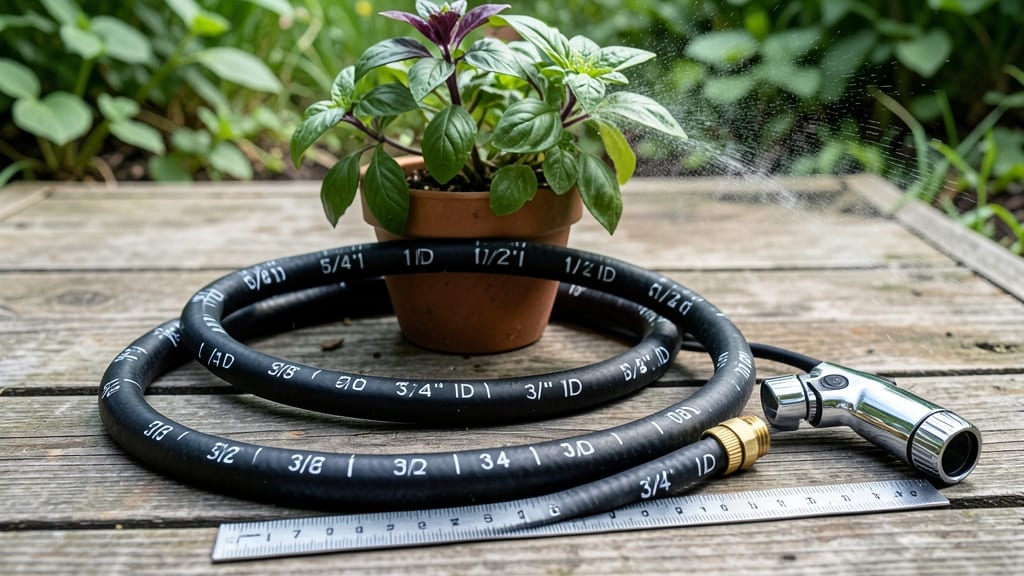
The inside diameter of a garden hose directly impacts water flow and pressure, with common residential sizes ranging from 3/8-inch to 5/8-inch. To find yours, measure the inner opening with a ruler or check the manufacturer's specs for precise sizing.
The inner diameter (ID) of your hose controls how much water can pass through—thicker hoses deliver more water at higher pressure, while thinner ones restrict flow. 🔥 For example, a 5/8-inch hose will water your lawn faster than a 3/8-inch one, but may require stronger pumps.
Most gardeners use 1/2-inch hoses as a balance between performance and flexibility. If you're running drip irrigation, a smaller diameter works perfectly, while larger hoses suit high-volume sprinklers or soaker hoses.
Pro tip: If your hose feels weak or sputters, the ID might be too small for your water source's pressure. Always match the hose size to your gardening needs—overkill wastes water, while undersized hoses leave plants thirsty.
💡 In This Article
- How Inside Diameter Affects Water Flow and Pressure
- Choosing the Right Garden Hose Size for Your Needs
How inside diameter affects water flow and pressure
The inside diameter (ID) of a garden hose determines how efficiently water moves through it using basic fluid dynamics principles. Larger diameters create less resistance, allowing more water to flow per minute while reducing pressure loss over distance.
Think of it like a highway: a wider lane (larger ID) handles more traffic (water) with fewer slowdowns (pressure drops). For example, a 5/8-inch hose delivers about 20 gallons per minute (GPM) at 40 psi, while a 3/8-inch hose struggles with just 10 GPM at the same pressure.
Pressure drop occurs because water molecules collide with the hose walls, creating friction.
In narrower hoses, this friction builds up faster, reducing both flow rate and pressure at the nozzle. 🔥 For a 50-foot hose, a 1/2-inch ID might lose 10-15 psi from your water source, while a 5/8-inch ID loses only 5-10 psi.
This matters for high-pressure tasks like cleaning driveways or running sprinklers—smaller hoses force your pump to work harder, increasing energy costs and wear.
For gardeners, this translates directly to irrigation efficiency. A 1/2-inch hose works well for hand-watering or drip systems, while a 5/8-inch ID handles high-volume sprinklers without clogging.
The key is matching the ID to your water source's pressure and your plants' needs—overkill wastes water, while undersized hoses leave you chasing leaks or weak streams.
Real-world example: My neighbor's 3/8-inch hose couldn't reach the far corners of his yard, so he upgraded to 5/8-inch. The difference was immediate—his sprinkler system now covers twice the area with consistent pressure, and he waters in half the time.
The trade-off? Larger hoses are heavier and more expensive, but the efficiency gain makes them worth it for big gardens.
Advanced consideration: If you're using a pressure-compensating nozzle, a smaller ID might work because the nozzle adjusts flow automatically. But for fixed nozzles or sprinklers, always choose the largest ID your water source can handle without losing too much pressure.
A good rule of thumb: 1/2-inch for most residential use, 5/8-inch for high-demand tasks.
Pro tip: Measure your hose's ID by inserting a ruler or caliper into the opening—most hoses are slightly smaller than their advertised size due to wall thickness. For instance, a "5/8-inch" hose might actually measure 0.60 inches inside. This tiny difference adds up over long distances! 💫